
They’re the ones who always seem to understand you—the quiet souls with x-ray empathy, the intuitive counselors who hold your pain like it’s their own. But what if the INFJ’s gift for healing others is rooted in a wound they rarely show?
This post is about more than just personality theory. It’s about the unspoken grief that fuels the INFJ’s insight—and how shadow work can become the doorway to reclaiming lost parts of themselves.
For the INFJ, shadow work isn’t just a psychological exercise—it’s a Plutonian transformation. One that asks you to descend inward, witness your own unconscious motives, and return with the power of integration.
By blending Carl Jung’s concept of the shadow, Beebe’s eight-function model of personality, and Pluto’s archetype of destruction and rebirth, we’ll walk through a map of the INFJ psyche—and what it takes to bring the unconscious into healing light.
Shadow work isn’t about fixing what’s broken—it’s about reclaiming what’s been buried.
- Key Takeaways
- The INFJ Personality – Light and Shadow
- INFJ Shadow Functions – The Four Faces of the Unconscious
- INFJ Emotional Wounds and Recurring Relationship Patterns
- Signs Your INFJ Shadow Is in Control
- Shadow Work for INFJs – Practical Integration Techniques
- Love, Boundaries, and the Integrated Heart
- The Plutonian Transformation – Rising Through the Shadow
- Conclusion: Shadow Work as a Lifelong Love Letter to the Self
- Frequently Asked Questions
- Explore More on the INFJ Personality Type from a Plutonian Lens
Key Takeaways
- INFJs access deep healing by exploring their shadow functions
- Grip stress responses signal burnout and overreliance on unconscious functions
- Shadow behaviors include perfectionism, emotional withdrawal, and projection
- Integration requires both emotional self-awareness and body-based practices
- Love becomes sustainable when INFJs honor their own needs and boundaries
The INFJ Personality – Light and Shadow

INFJs are guided by a unique set of internal tools:
Their dominant function, Introverted Intuition (Ni), helps them spot patterns and meanings that others miss. Extraverted Feeling (Fe) allows them to create emotional harmony, often making them the trusted confidant in others’ lives. Introverted Thinking (Ti) quietly refines their logic behind the scenes, while Extraverted Sensing (Se) helps them engage with the sensory world—though often with some discomfort.
But INFJs are not immune to imbalance.
Under prolonged stress, their personality structure flips inward, triggering their unconscious or “shadow” functions. These are Extraverted Intuition (Ne), Introverted Feeling (Fi), Extraverted Thinking (Te), and Introverted Sensing (Si).
These functions are not inherently negative, but because they operate outside of the INFJ’s conscious comfort zone, they tend to show up in distorted or reactive forms.
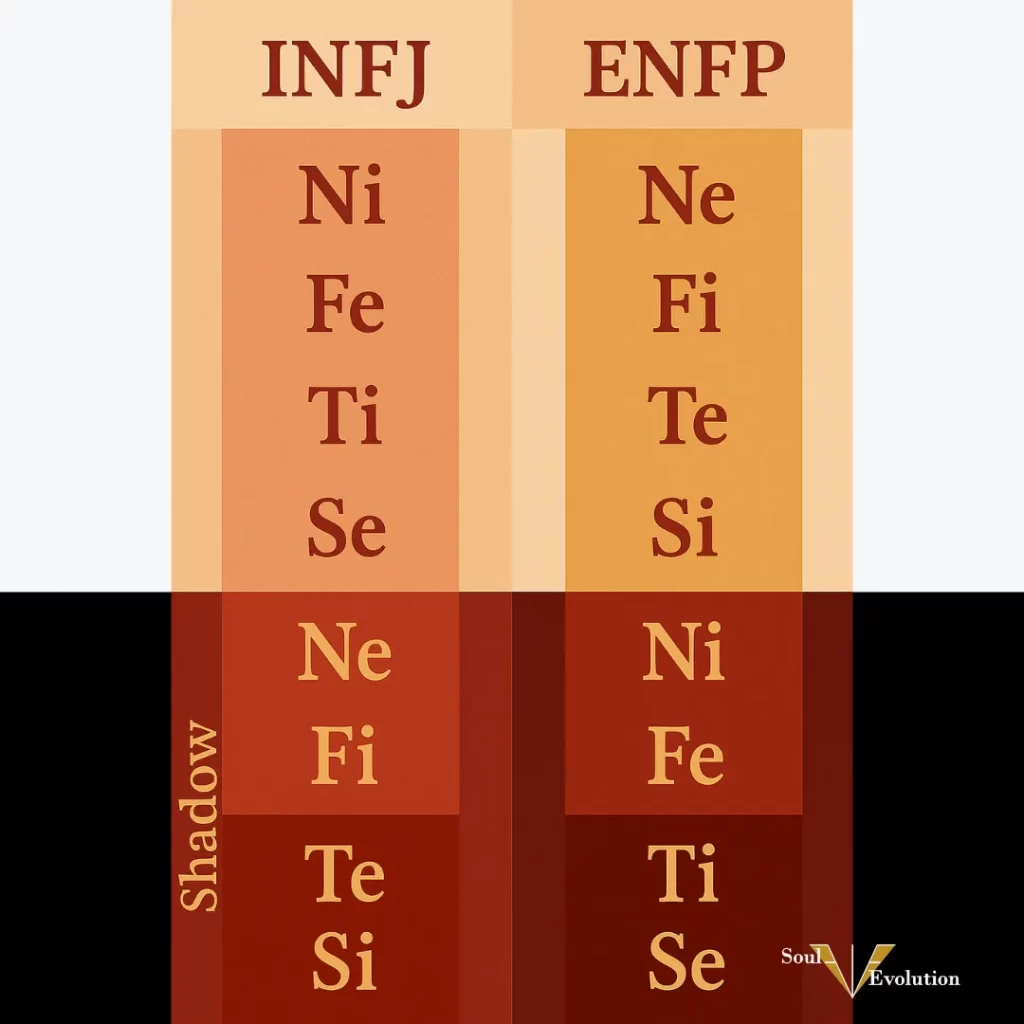
Interestingly, these four shadow functions are the same ones that make up the dominant cognitive stack of an ENFP. However, that doesn’t mean that an INFJ operating from their shadow begins acting like an ENFP.
Quite the opposite—because these functions are unfamiliar and often unintegrated, they tend to emerge in warped, exaggerated ways. Think of it like speaking a foreign language without fluency: the expression is awkward, strained, or even destructive until intentional integration work brings clarity and balance.
When these shadow aspects take the wheel, INFJs might feel like strangers to themselves—overthinking every possibility, critiquing themselves harshly, or fixating on past wounds.
These behaviors can feel disorienting or even shame-inducing, but they are signals to look inward and tend to what’s been suppressed. Learning to recognize them isn’t a sign of weakness—it’s the first courageous step toward integration and self-trust.
Related Reading: What Is the Shadow Self?
INFJ Shadow Functions – The Four Faces of the Unconscious
| Shadow Archetype | Function | Shadow Manifestation |
| Opposing Personality | Extraverted Intuition (Ne) | Overthinking, decision paralysis |
| Witch/Senex (Critical Parent) | Introverted Feeling (Fi) | Harsh inner critic, moral rigidity |
| Trickster | Extraverted Thinking (Te) | Hypercriticism, controlling behaviors |
| Demon | Introverted Sensing (Si) | Trauma loops, past fixation |
These archetypes aren’t abstract—they often play out in everyday life, especially when INFJs feel unsupported, misunderstood, or emotionally depleted.
The Opposing Personality might turn a clear intuitive insight into an anxious spiral of “what ifs.” The Witch/Senex might demand impossible moral purity, turning self-care into guilt. The Trickster can distort well-meaning logic into verbal jabs or micromanagement. And the Demon, perhaps the most haunting of all, can drag old traumas into the present with a vengeance.
These manifestations don’t mean something is “wrong” with the INFJ. They are signals from the unconscious—parts of the psyche asking for acknowledgment, not shame.
Why Do INFJs Start Acting from the Shadow?
INFJs don’t wake up one day and decide to operate from their shadow. It’s usually a gradual slide—sparked by emotional overwhelm, chronic invalidation, or the compounding weight of unmet needs.
Over time, the dominant and auxiliary functions (Ni and Fe) may become depleted or distorted from overuse, and the INFJ psyche begins to reach for whatever tools are left—namely, the unconscious shadow functions.
Another possibility is what psychologists call “grip stress.”
What Is Grip Stress?

Coined by psychologist Naomi Quenk, the term refers to moments when a personality type becomes overwhelmed by prolonged stress, and instead of using their usual strengths, they slip into their inferior function in a reactive, exaggerated way.
For INFJs, this means temporarily abandoning their usual intuitive and feeling-based decision-making (Ni-Fe) and acting through their least-developed function, Extraverted Sensing (Se).
This shift is not conscious—it’s like being hijacked by a stranger within. The INFJ might suddenly crave overstimulation, seek impulsive thrills, or compulsively consume food, entertainment, or shopping. It’s the psyche’s way of trying to ground itself, but it often backfires, leading to more disconnection and shame.
Recognizing a grip state isn’t a failure—it’s an invitation to slow down and re-center. When INFJs learn to recognize these symptoms, they can begin to ground through healthier Se practices (like movement, breathwork, or time in nature) rather than reactive overindulgence.
This is often a red flag of burnout and a sign that deeper integration work is needed.
Reflection Prompt: When I feel overwhelmed, what unconscious behaviors tend to take over? Can I trace them back to one of these shadow archetypes?
INFJ Emotional Wounds and Recurring Relationship Patterns
Many INFJs carry early emotional wounds—being told they were “too sensitive,” being praised only for their helpfulness, or learning that their needs were inconvenient. These experiences often imprint a core belief: I must earn love by disappearing into others’ needs.

As adults, this can manifest as chronic people-pleasing, emotional over-functioning, or relationships where the INFJ gives far more than they receive. They may attract wounded or emotionally unavailable partners, believing unconsciously that love must be worked for or rescued.
Over time, this “Wounded Healer” dynamic becomes self-erasure. INFJs become the emotional caretakers of everyone but themselves—leading to an internal sense of invisibility.
This is one of the core reasons INFJs often feel deeply misunderstood in relationships. They may be seen as supportive or even selfless, while internally feeling unseen, unmet, or emotionally alone.
These unresolved wounds also make fertile ground for shadow behaviors. The more INFJs suppress their needs or invalidate their own pain, the more likely it is that their shadow functions will surface in reactive ways—withdrawal, overthinking, guilt, or emotional projection. Without conscious tending, the inner healer can become the inner saboteur.
“When INFJs become unhealthy, they can become withdrawn and out of touch with the world around them.” — Psychology Junkie
But this withdrawal isn’t always visible. Often, INFJs stay physically present while emotionally vanishing, suppressing their own truth to maintain connection.
Self-reflection Prompt: In what ways have I silenced my needs to keep a relationship intact?
Signs Your INFJ Shadow Is in Control

Shadow behaviors can be subtle—or deeply disruptive. When the INFJ shadow is in control, the personality feels “off.” It’s like the inner compass has been scrambled, and your usual strengths are replaced by compulsions, fear, or emotional shutdowns.
Common manifestations include:
- Harsh inner and outer criticism — a sign of Trickster Te or Witch Fi taking the reins.
- Decision paralysis from obsessive overthinking — often driven by Opposing Ne’s fear of making the wrong choice.
- Impulsive spending, eating, or escapism — indicators of Se grip stress and disconnection from intuitive guidance.
- Emotional withdrawal or isolating from loved ones — usually a response to vulnerability fatigue and unmet relational needs.
- Projecting internal struggles onto others — a defense mechanism rooted in disowned feelings and unmet shadow needs.
These patterns don’t mean something is wrong with you—they mean something within you is asking to be seen, heard, and integrated.
Journaling Prompt: When was the last time I projected a fear or unmet need onto someone else? What was I really needing in that moment?
Shadow Work for INFJs – Practical Integration Techniques
Shadow work can feel abstract, especially for the deeply internal INFJ. But integration begins with intentional practices that bring the unconscious into relationship with the conscious self.
These tools don’t just reveal what’s been hidden—they help INFJs reclaim their inner authority and rewire how they respond to stress, relationships, and emotional overwhelm.
1. Archetypal Dialogue – Bridging Inner Polarities
One powerful method is to pair INFJ’s primary functions with their shadow counterparts in guided inner dialogue. This helps create psychological balance, softening oppositional tension.
- Ni ↔ Ne: Practice divergent thinking with curiosity—not fear. Allow imaginative possibilities without collapsing into anxiety.
- Fe ↔ Fi: Affirm your own needs and values as equally sacred to others’. This is the foundation of emotional boundary repair.
- Ti ↔ Te: Use structured logic dialogues with safe people or in journaling to challenge rigid thinking without becoming defensive.
- Se ↔ Si: Root into the present through mindful sensation, and reinterpret the past with compassion instead of looping shame.
Try: Journaling as different parts of yourself. You might write a conversation between “The Visionary” (Ni) and “The Worrier” (Ne), or use fictional characters to explore internal conflict with safety.
2. Mind-Body Connection – Reclaiming the Present Moment
INFJs often dissociate from their physical bodies when overwhelmed. Shadow work isn’t only emotional—it’s somatic. Reconnecting with the body restores trust and helps INFJs ground instead of spiral.
- Use Se consciously: Walk barefoot, stretch slowly, dance freely. Let your senses bring you back to now.
- Heal Si loops: Practices like EMDR or inner child meditations help INFJs revisit the past safely and reframe traumatic imprints.
3. Therapeutic Modalities – Externalizing the Shadow
When shadow material feels too tangled to untangle alone, external tools can create containers for healing:
- EMDR Therapy: Especially useful for processing trauma stored in Si (demon) memory loops.
- Narrative Therapy: Helps externalize inner critics—e.g., “The Judge” or “The Perfectionist”—so they can be understood, not obeyed.
- Creative Shadow Expression: Write letters from the Trickster. Draw the Witch. Sculpt the Demon. Giving these energies a face invites transformation instead of fear.
Love, Boundaries, and the Integrated Heart

For INFJs, relationships can be both a source of deep connection and a mirror for their most vulnerable shadows. Many struggle with feeling unseen or emotionally depleted—not because they don’t give enough, but because they struggle to receive.
Transforming their love lives doesn’t begin with a partner—it begins within. Integration in love means rebuilding trust with the self, restoring the belief that your needs are valid and your boundaries are sacred.
It means learning to:
- Receive support, not just give it
- Set boundaries without guilt
- Trust your intuition even when it’s uncomfortable
When INFJs neglect their own needs for too long, resentment, projection, and emotional burnout can surface. But when they reconnect to their inner truth, relationships become a space of mutual growth rather than emotional sacrifice.
Affirmation: “It’s not selfish to have needs—it’s self-aware.”
Explore Further: Pluto in the 7th House Shadow Questions
The Plutonian Transformation – Rising Through the Shadow

In astrology, Pluto teaches us that rebirth always follows destruction. For INFJs, shadow work could be the alchemical fire—the psychological death that makes room for emotional rebirth.
At its heart, Pluto represents evolution through honesty, intensity, and surrender. Shadow work doesn’t just help INFJs feel better—it can help them become more whole. It invites them to stand in the wreckage of old patterns and choose, again and again, to rise.
That said, shadow work isn’t for everyone. It requires emotional safety, self-trust, and a willingness to face uncomfortable truths. If this post resonated with you, it may be a sign that your soul is ready—or already walking—the path of integration. INFJs with strong Pluto influences in their natal chart (such as Pluto conjunct the Sun, Moon, or Ascendant) may feel especially pulled toward this kind of deep, inner transformation.
You are invited to witness how your most painful patterns are actually asking for evolution. When you no longer fear your own intensity, you stop fearing your own power.
“Pluto doesn’t destroy to harm—it destroys to reveal.”
Conclusion: Shadow Work as a Lifelong Love Letter to the Self
True integration is not about being perfect—it’s about being whole. Shadow work is not a one-time fix; it’s a sacred commitment to stay present with your own complexity.
For INFJs, this process can feel like emotional alchemy: turning old pain into wisdom, self-sacrifice into self-respect, and longing into authentic love.

If this post resonated, you might also find comfort and clarity in my book INFJs in Relationships—a compassionate guide to navigating love, boundaries, and emotional healing from the INFJ perspective.
And if something here touched you, consider sharing it with fellow INFJs in your community or online spaces. You never know who might be silently struggling—and your share might offer them a path to healing.
Journal Prompt: What part of me is asking to be loved, not fixed?
Let me know in the comments: Which INFJ shadow trait have you most struggled with—and what helps you bring it into the light?